谁和George Dyer约会过?
Francis Bacon 日期为 George Dyer,从 ? 到 ?.
George Dyer
Francis Bacon (28 October 1909 – 28 April 1992) was an Irish-born British figurative painter known for his raw, unsettling imagery. Focusing on the human form, his subjects included crucifixions, portraits of popes, self-portraits, and portraits of close friends, with abstracted figures sometimes isolated in geometrical structures.
He said that he saw images "in series", and his work, which numbers in the region of 590 extant paintings along with many others he destroyed, typically focused on a single subject for sustained periods, often in triptych or diptych formats. His output can be broadly described as sequences or variations on single motifs; including the 1930s Picasso-influenced bio-morphs and Furies, the 1940s male heads isolated in rooms or geometric structures, the 1950s "screaming popes", the mid-to-late-1950s animals and lone figures, the early-1960s crucifixions, the mid-to-late-1960s portraits of friends, the 1970s self-portraits, and the cooler, more technical 1980s paintings.
Bacon did not begin to seriously focus on painting until his late twenties, having drifted in the late 1920s and early 1930s as an interior decorator, bon vivant and gambler. He said that his artistic career was delayed because he spent too long looking for subject matter that could sustain his interest. His breakthrough came with the 1944 triptych Three Studies for Figures at the Base of a Crucifixion, which sealed his reputation as a uniquely bleak chronicler of the human condition. From the mid-1960s, he mainly produced portraits of friends and drinking companions, either as single, diptych or triptych panels. Following the suicide of his lover George Dyer in 1971 (memorialised in his Black Triptychs, and a number of posthumous portraits), his art became more sombre, inward-looking and preoccupied with the passage of time and death. The climax of his later period is marked by the masterpieces Study for Self-Portrait (1982) and Study for a Self-Portrait—Triptych, 1985–86.
Despite his existentialist and bleak outlook, Bacon was charismatic, articulate and well read. A bon vivant, he spent his middle age eating, drinking and gambling in London's Soho with like-minded friends including Lucian Freud (although they fell out in the mid-1970s, for reasons neither ever explained), John Deakin, Muriel Belcher, Henrietta Moraes, Daniel Farson, Tom Baker and Jeffrey Bernard. After Dyer's suicide, he largely distanced himself from this circle, and while still socially active and his passion for gambling and drinking continued, he settled into a platonic and somewhat fatherly relationship with his eventual heir, John Edwards. Since his death, Bacon's reputation has grown steadily, and his work is among the most acclaimed, expensive and sought-after on the art market. In the late 1990s, a number of major works, previously assumed destroyed, including early 1950s pope paintings and 1960s portraits, re-emerged to set record prices at auction.
阅读全文...Francis Bacon
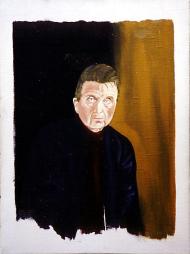
法蘭西斯·培根(英語:Francis Bacon,1909年10月28日—1992年4月28日)是一位生于爱尔兰的英国画家,為同名英國哲學家異母兄的後代。其作品以粗犷、犀利,具强烈暴力与噩梦般的图像著称。中后期作品主体为在狭小空间内的玻璃或金属几何笼子里的抽象雄性肖像,背景通常为极平坦的平面。
阅读全文...